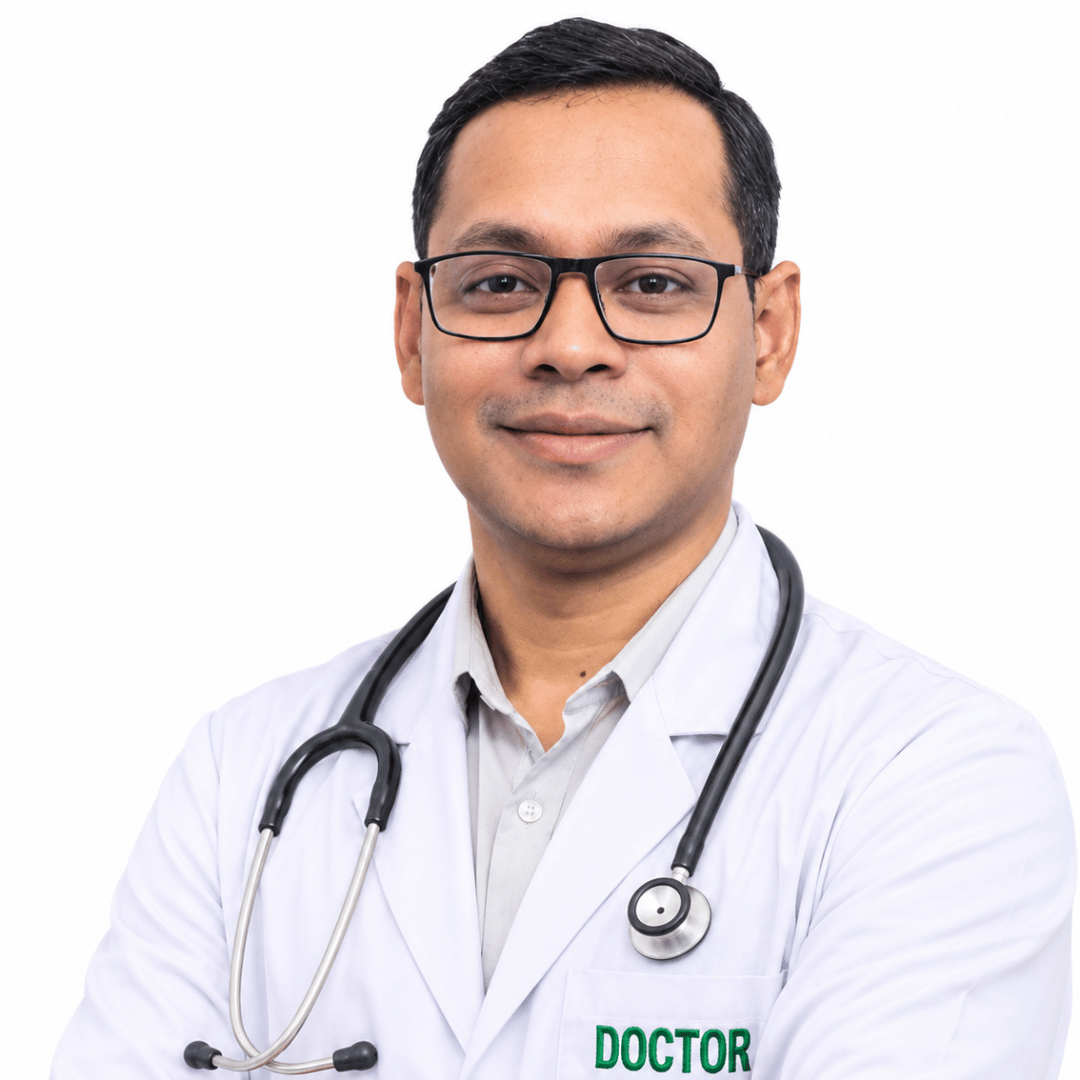
Dr. Nirupom Mondal – Kidneys, Bladder, Ureters, Prostate Specialist & Laparoscopic Surgeon in Khulna
Dr. Nirupom Mondal is a Consultant Urologist at Khulna Medical College & Hospital, Khulna, with over 14 years of distinguished clinical, surgical, and academic experience. As an eminent Urologist and Andrologist, he provides expert care for benign prostatic conditions, urolithiasis (kidney/ureter stones), erectile dysfunction, overactive bladder, and urethral strictures. Patients seeking expert evaluation receive evidence-based treatments tailored to ensure safe procedures and rapid recovery. His medical practice combines high-precision surgical diagnostics with individualized patient care plans.
Professional Biography
Dr. Nirupom Mondal completed his MBBS degree, establishing a comprehensive clinical foundation. He entered the BCS (Health) cadre and pursued rigorous postgraduate specializations, earning his Master of Surgery (MS) in Urology. Further demonstrating his surgical excellence globally, he attained the prestigious Fellowship of the American College of Surgeons (FACS, America)—a premier qualification dedicated to the highest international standards of operative care in urology and andrology. Finding the best Urologist in Khulna leads patients to rely on his 14+ years of academic leadership and specialized clinical expertise.
His primary clinical focus includes advanced endourology for urolithiasis care, transurethral resection for benign prostatic hyperplasia, reconstructive surgery for urethral strictures, and targeted psychosexual and medical therapies for erectile dysfunction. His diagnostic framework incorporates advanced uroflowmetry, diagnostic cystoscopy, renal ultrasonography, and comprehensive risk stratification to formulate effective, long-term care strategies.
At-a-Glance Profile Card
| Profile Field | Details |
| Full Name | Dr. Nirupom Mondal |
| Primary Specialty | Urology & Andrology |
| Secondary Specialties | Endourology, Laparoscopic Surgery & Male Infertility |
| Designation | Consultant (Urology) |
| Workplace | Khulna Medical College & Hospital, Khulna |
| Total Experience | 14+ Years |
| Location | Khulna, Bangladesh |
Qualifications & Education
MBBS – Bachelor of Medicine and Bachelor of Surgery
BCS (Health) – Bangladesh Civil Service (Health Cadre)
MS (Urology) – Master of Surgery in Urology
FACS (America) – Fellow of the American College of Surgeons, USA
Designation & Workplace
Designation: Consultant (Urology)
Workplace: Department of Urology, Khulna Medical College & Hospital, Khulna
Diseases Treated
Benign prostatic hyperplasia (BPH) requires precision prostate resection.
Urolithiasis demands advanced laser lithotripsy and stone removal.
Erectile dysfunction needs comprehensive andrological evaluation and therapy.
Overactive bladder requires targeted pharmacological and behavioral care.
Urethral stricture demands specialized reconstructive urethroplasty.
Kidney tumors require oncological evaluation and nephrectomy.
Male infertility needs advanced microsurgical interventions.
Urinary tract infections (UTI) demand targeted antibiotic therapy.
Prostatitis requires chronic pelvic pain management.
Hydrocele requires precise surgical excision.
Varicocele demands laparoscopic or microsurgical ligation.
Bladder cancer needs cystoscopic tumor resection (TURBT).
Urinary incontinence demands urodynamic evaluation and sling surgery.
Testicular torsion requires emergency scrotal exploration.
Phimosis demands safe and hygienic circumcision.
Clinical Specialties & Treatment Areas
Endourology & Stone Management: Specialized minimally invasive protocols for removing kidney, ureter, and bladder stones using laser technology.
Prostate & Reconstructive Urology: Precision surgical management for enlarged prostate (BPH), prostate cancer, and restoring the urinary tract from strictures.
Andrology & Male Sexual Health: Advanced diagnostic and therapeutic interventions for male infertility, erectile dysfunction, and penile anomalies.
Advanced Procedure Breakdown
Laser Lithotripsy & URSL (Ureteroscopic Lithotripsy)
A highly advanced, no-incision endoscopic procedure where a fine scope is passed through the urethra to locate stones in the ureter or kidney, utilizing a laser to break them into dust for natural, painless passage.
Transurethral Resection of the Prostate (TURP)
The gold-standard minimally invasive surgery for severe BPH. A specialized resectoscope is used to core out the obstructing prostate tissue from within the urethra, instantly relieving urinary blockage without external cuts.
Optical Internal Urethrotomy (OIU) & Urethroplasty
Precision techniques to treat urethral strictures (narrowing of the urine tube). OIU uses an endoscopic knife or laser to open the stricture, while urethroplasty is a definitive reconstructive surgery utilizing tissue grafts to permanently widen the passage.
Condition-Specific Deep Dives
Benign Prostatic Hyperplasia (BPH)
A non-cancerous enlargement of the prostate gland common in aging men. It compresses the urethra, causing weak urine flow, frequent nighttime urination, and the inability to empty the bladder completely, necessitating medical or surgical relief.
Urolithiasis (Kidney and Ureter Stones)
Hard deposits of minerals and acid salts that form inside the kidneys. When they migrate into the ureter, they cause excruciating flank pain, nausea, and blood in the urine. Modern treatment heavily relies on non-invasive or endoscopic laser pulverization.
Erectile Dysfunction (ED)
The consistent inability to achieve or maintain a firm erection suitable for sexual intercourse. It often serves as an early warning sign for underlying cardiovascular, endocrine, or neurological issues, requiring a holistic andrological workup before initiating phosphodiesterase inhibitors or targeted therapies.
The Doctor’s Clinical Approach
Dr. Nirupom Mondal combines meticulous clinical examination with advanced urological imaging and evidence-based medicine. His philosophy emphasizes patient education, prioritizing minimally invasive laparoscopic and endoscopic techniques to reduce post-operative pain, and structuring holistic recovery protocols that restore both urinary and sexual function.
Specialized Risk Factors
Emergency Callout: Immediate emergency medical evaluation is required if a patient experiences acute urinary retention (absolute inability to pass urine), sudden severe flank pain accompanied by high fever and chills (infected obstructed kidney), painless visible blood in the urine (hematuria), or severe, sudden-onset testicular pain (possible torsion).
Certifications & Professional Memberships
Member, Bangladesh Medical and Dental Council (BMDC)
Fellow, American College of Surgeons (FACS)
Member, Bangladesh Association of Urological Surgeons (BAUS)
Patient Visit Preparation Checklist
Bring all prior diagnostic imaging films (USG KUB, CT Urogram), Uroflowmetry reports, and Serum PSA test results.
Maintain a complete list of current prescription medications, especially blood thinners or blood pressure drugs.
Keep a detailed voiding diary noting fluid intake, urination frequency (day and night), and episodes of leakage.
Ensure a family member accompanies the patient if a surgical procedure or cystoscopy is anticipated.
Last Modified: October 22, 2026